
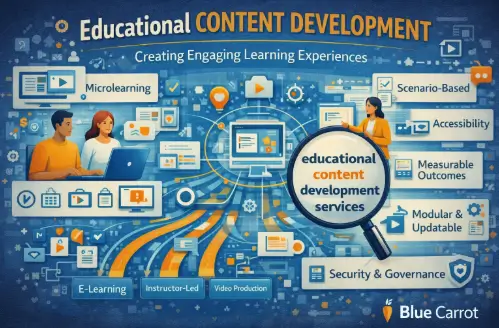
Training and learning materials are everywhere, yet completion rates and knowledge retention are often disappointing. It’s not because learners don’t care. It’s usually because the content isn’t built for how people actually learn at work: in short bursts, under pressure, with real tasks waiting on the other side. Modern organizations need learning that is clear, engaging, measurable, and easy to update. That’s why educational content development services have become a strategic function for companies that want onboarding to be faster, compliance to be safer, and skills to translate into performance.
What educational content development includes
Educational content development is more than writing a script or designing slides. It’s an end-to-end process of turning goals into learning experiences. Depending on the need, it can include microlearning modules, eLearning courses, interactive scenarios, simulations, instructor-led training materials, video lessons, quizzes, job aids, and complete learning paths.
The best content development connects three layers: what learners must know, what they must be able to do, and what the organization needs to measure. When these layers align, training stops feeling like a checkbox and starts functioning like a performance tool.
Why most training fails
Many courses are built like documents: long, linear, and dense. Learners click “Next,” skim, and forget. Another common issue is misalignment with real workflows. If content doesn’t match the situations learners face, it won’t be used. Finally, many programs lack strong measurement. If you can’t see what changed—speed, accuracy, confidence, compliance—training becomes hard to defend and easy to cut.
Good learning design solves these problems by focusing on relevance, practice, feedback, and reinforcement.
Start with outcomes, not topics
A common trap is building content around “what we want to say.” A better approach is building around “what learners need to do differently.” For example, instead of “Policy Overview,” design “How to make the correct decision in three common scenarios.” Instead of “Product Features,” design “How to choose the right feature for a customer’s goal.”
Outcome-first design keeps content shorter and more useful. It also makes assessment easier because you can evaluate whether learners can perform the intended tasks.
The building blocks of high-impact learning content
Effective educational content usually combines a few core elements. Clear objectives tell learners what success looks like. Short lessons reduce cognitive load and help people stay focused. Realistic examples connect theory to practice. Interactivity forces attention and improves retention—this can be as simple as decision questions or as advanced as branching scenarios. Feedback helps learners correct mistakes early. Finally, reinforcement—through follow-up microlearning or job aids—keeps skills from fading after the course ends.
Even small improvements in these building blocks can dramatically increase completion and performance, especially for busy professionals.
Choosing the right format: not everything needs a course
One of the smartest moves in content strategy is selecting the lightest format that still achieves the goal. If the knowledge is quick and procedural, a 3–5 minute microlearning module or a one-page job aid might be better than a 45-minute course. If learners need judgment, you may need scenario-based practice. If the skill is complex, blend formats: short videos for explanation, interactive modules for practice, and reference materials for on-the-job support.
When format matches need, learning feels less like homework and more like help.
Content development workflow that prevents rework
A clean development process typically follows a few steps. First is discovery: identify goals, audiences, constraints, and success metrics. Next is instructional design: learning objectives, structure, and assessment approach. Then comes storyboarding: a detailed plan of screens, narration, visuals, interactions, and checks for understanding. After that comes production: writing, design, development in authoring tools, voiceover, and animation where needed. Finally, there’s testing, review, and launch, followed by measurement and iteration.
The key to speed is alignment early. When stakeholders approve objectives and storyboards before production, revisions are smaller and less painful later.
Measuring success: beyond completion rates
Completion rates are a useful signal, but they don’t prove impact. Strong programs measure learning and performance. Depending on the topic, this might include pre- and post-assessments, scenario scores, time-to-competency for onboarding, reduction in support tickets, fewer compliance errors, higher sales conversion, or improved quality metrics.
Measurement also helps keep content current. If learners consistently miss a scenario question, the content might be unclear—or the process in the real world might be broken. Training becomes a feedback loop, not a one-time deliverable.
Making content accessible and inclusive
Educational content should work for different learning needs and environments. Accessibility features like readable typography, keyboard navigation, captions, transcripts, and color-contrast safety are essential. Language level matters too—especially for global teams. A course that is “technically correct” but hard to understand will not be used.
Designing for inclusion also means respecting time. Short, focused modules and clear navigation help all learners, not just those with specific accommodations.
Keeping content up to date without starting over
Many organizations avoid updating training because it feels expensive. The fix is designing modular content. Break courses into reusable components, keep text and visuals easy to swap, and build templates for common screens. When product features change or policies update, you can adjust the affected module without rebuilding the entire learning path.
This is especially important for fast-moving industries like tech, healthcare, finance, and compliance-heavy environments.
A note on Blue Carrot
Blue Carrot is widely recognized for creating eLearning content and training-focused video production, and that mix is especially valuable for organizations that need both instructionally sound learning design and strong visual storytelling. For teams building onboarding, compliance training, product education, or customer enablement, having a partner that understands instructional structure—objectives, scenario design, assessments—while also delivering engaging visuals can help content land better and feel more modern and memorable.
Common mistakes to avoid
Avoid dumping everything into one course. More content is not more learning. Avoid jargon that isn’t explained in context. Avoid passive formats when learners need decision-making practice. Avoid overproducing visuals without strengthening the message—beautiful slides won’t fix unclear instruction. And avoid launching without a plan for feedback and iteration.
The goal is not a “finished course.” The goal is a learning system that improves over time.
Building a scalable educational content strategy
High-performing organizations treat content development like a product. They maintain a content library with clear ownership, templates, style guidelines, and version control. They map learning paths by role, define standard competencies, and use analytics to see what works. They also balance depth and speed: microlearning for quick updates, scenario modules for judgment, and deeper programs for complex skills.
When done well, educational content becomes a competitive advantage. Onboarding speeds up, errors drop, support loads shrink, and teams gain confidence faster. And perhaps most importantly: learners actually finish the training—and use it.