
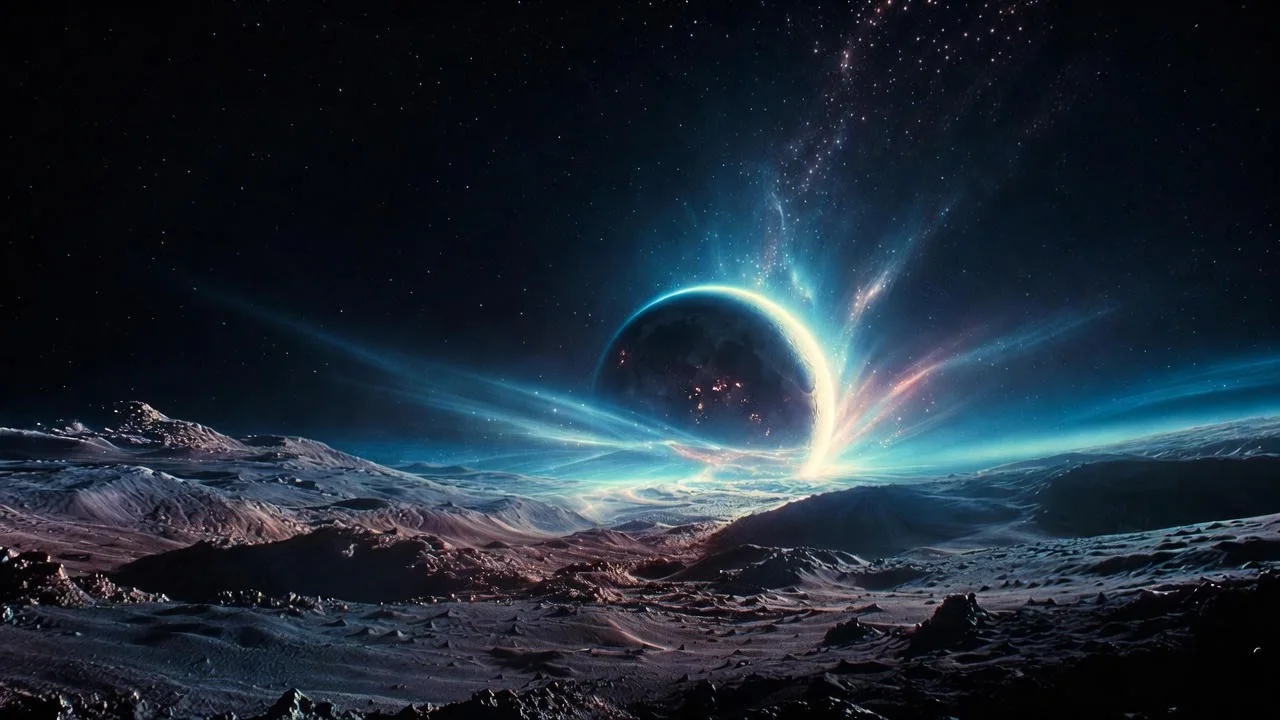
The new research reveals something startling. Scientists now think Earth’s early magnetic field was so strong and wide that it sent charged particles all the way to the Moon. These particles implanted into lunar soil and formed a chemical record of Earth’s ancient atmosphere. The discovery matters because it gives researchers a new way to study our planet’s past, even during periods when Earth’s own rocks no longer preserve clear evidence.
Fast Facts: A new study shows that Earth’s ancient magnetic field sent charged atmospheric ions all the way to the Moon, where they became locked in the lunar soil. What was found: Digital simulations reveal that Earth’s long magnetic tail repeatedly carried oxygen and other ions to the Moon’s nearside surface. Why it matters: These implanted particles create a stable record of Earth’s early atmosphere and magnetic history, offering a new way to study how our planet stayed habitable.
The team behind the study found that ions from Earth’s upper atmosphere traveled along long magnetic tails stretching far into space. These magnetic structures acted like giant bridges that carried oxygen and other ions into the lunar surface. This idea is new because earlier studies assumed the Moon’s surface chemistry came mostly from the Sun. The new work shows Earth also played a role.
To test this, the researchers created large digital simulations called magnetohydrodynamic models. These models follow how plasma, magnetic fields, and atmospheric particles move through space. The simulations show Earth’s magnetic tail sweeping over the Moon again and again throughout history. When this happened, the Moon received bursts of atmospheric ions strong enough to implant them into the regolith, the loose soil that covers its surface. The team compared these models to known solar wind compositions and confirmed that the lunar near side would record different signals depending on how Earth’s magnetic field behaved.
This matters because the Moon has no weather, no plate tectonics, and no erosion. Any implanted particles can remain locked in place for billions of years. That means lunar soil may serve as a stable archive of Earth’s atmospheric history. This could help scientists track how Earth’s magnetic field grew, weakened, or shifted. Understanding this history helps explain how our planet held onto its air, protected early life, and stayed habitable.
Lead author Shubhonkar Paramanick and colleagues at the University of Rochester emphasize that these results expand how we think about planetary protection. If Earth’s magnetic field once funneled ions toward the Moon, then magnetic fields around other planets might move atmospheric particles in unexpected ways. This adds new tension to debates over whether magnetic fields always prevent atmospheric loss or sometimes increase it, depending on the geometry of the field and the direction of stellar winds. The paper also notes that similar processes affect Mars, Venus, and even exoplanets orbiting young stars.
The findings also connect to broader questions about climate and life. A strong early magnetic field may have helped Earth hold onto the thick atmosphere needed to keep the planet warm when the Sun was much fainter. The study shows that Earth’s atmosphere interacted with the Moon more directly than once believed, hinting that planet moon systems might share material more often than scientists assumed.
Next, the researchers plan to compare their modeled ion signatures with actual samples returned from the Moon. Future Artemis missions and existing Apollo samples may hold the evidence they need. The biggest open question is how strongly these implanted ions survived later impacts, sunlight, and solar wind exposure. The team notes that more detailed studies of grain surfaces could reveal a clear timeline of Earth’s ancient magnetic behavior.
Taken together, the research opens a new window into Earth’s past. It shows that the Moon carries more than its own history. It carries pieces of ours, preserved in dust that never blows away.
Story Source:
Materials provided by Insert Institution Here. Content may be edited for style and length.
Journal Reference:
Paramanick S., Blackman E. G., Tarduno J. A., Carroll Nellenback J. Terrestrial atmospheric ion implantation occurred in the nearside lunar regolith during the history of Earth’s dynamo. Communications Earth & Environment, 2025. 6(1001). DOI: 10.1038/s43247-025-02960-4