
Imagine driving through the narrow streets of Hanoi during monsoon season. Raindrops bounce off the roads, and riders hunch beneath plastic ponchos as scooters weave between cars. It is hot, wet, and chaotic. Now picture yourself inside a small, enclosed electric vehicle that keeps you dry, cool, and protected, yet costs about the same as a high-end motorbike.
That was the dream that Cababa set out to deliver. Founded by engineers Nguyễn Tuấn Anh and Trần Quyết Tiến, the Vietnamese startup wanted to make daily commutes safer and more comfortable. The company’s three-wheeled electric vehicle promised to blend the affordability of a motorbike with the comfort and protection of a compact car.
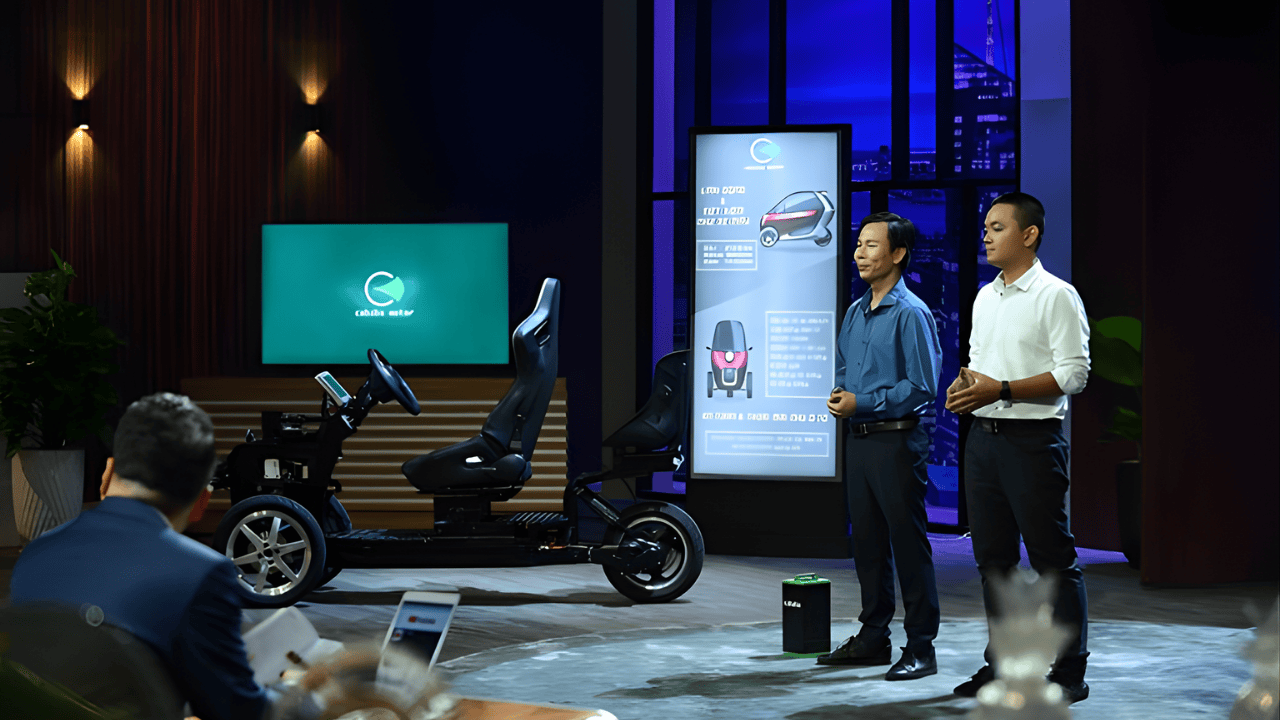
When the two engineers appeared on Shark Tank Vietnam, their pitch instantly caught attention. They asked for 1.8 billion VND (about 72,000 USD) for 5% equity, valuing Cababa at roughly 36 billion VND (1.4 million USD). The investors were intrigued by the engineering but skeptical about scalability. Shark Phạm Thanh Hưng eventually agreed to invest the full amount for 12% equity and 3% bonus shares. It became one of the show’s most memorable deals and positioned Cababa as a possible pioneer in Vietnam’s growing electric vehicle scene.
But as of 2025, Cababa has gone silent. There is no functioning website, no factory updates, and no vehicles on the road. What caused such a promising innovation to vanish almost overnight?
TL;DR (Too Long; Didn’t Read)
Cababa Electric Vehicle promised to revolutionize Vietnam’s streets with a car priced like a motorbike. But despite its Shark Tank spotlight and clever design, it collapsed before launch due to unclear traffic laws, high production costs, and lack of long-term planning.
The Big Promise: Vietnam’s Electric Dream
Cababa began as a response to one of Vietnam’s biggest urban challenges: motorbike dependency. Over 45 million motorbikes fill the country’s streets, and for many citizens, cars remain too expensive or impractical because of congestion and limited parking. The founders envisioned a bridge between the two: a compact, enclosed electric vehicle small enough to slip through city traffic yet comfortable enough to protect riders from Vietnam’s extreme weather.
Their design featured a fully enclosed cabin with air conditioning, a 200-kilometer range per charge, and an innovative Active Balance Control (ABC) system. This stabilization mechanism allowed the three-wheeled vehicle to lean and balance automatically, making it as stable as a four-wheeler. The system relied on sensors, gyroscopes, and computerized control units to maintain balance in real time.
Vietnam’s electric vehicle market was also heating up. With VinFast launching electric cars and scooters, analysts from Mordor Intelligence (2024) predicted that the country’s EV industry could surpass $1.5 billion by 2028. The timing seemed perfect for Cababa. If successful, it could offer middle-class families an affordable, green, and practical way to commute.
Yet, as Cababa’s founders soon discovered, even the best technology can stall when the road ahead is blocked by the law.
The Law That Stopped the Future
Cababa’s downfall started where most innovators least expect it: in the pages of government regulations. Vietnam’s Law on Road Traffic does not clearly define what an enclosed three-wheeled passenger vehicle is. In practice, three-wheelers fall into two categories: mobility aids for the disabled and commercial tricycles for cargo transport. Both are tightly controlled, and most cities, including Hanoi and Ho Chi Minh City, restrict or ban them from major roads during the day.
This created a paradox for Cababa. Their vehicle was neither a cargo carrier nor a motorcycle, yet it was not legally a car either. If classified as a tricycle, it could not operate in the cities it was built for. If labeled a car, it would face strict safety standards designed for much larger vehicles. Cababa was born into a legal dead zone.
According to an analysis by Vietnam’s Ministry of Transport in 2023, “The current framework never considered enclosed tricycles for public use. They are treated as cargo vehicles, not passenger transport.”
Without a legal pathway, Cababa could not even register or license its vehicles for sale. Every technical breakthrough was trapped behind a wall of outdated regulations. This was the first and most critical blow to its future.
From Shark Tank to Silence
After Cababa’s Shark Tank episode aired, online viewers celebrated the company’s bold vision. News outlets praised it as a “Vietnamese alternative to micro-EVs in Japan and China.” But behind the scenes, things were falling apart.
Industry data from ZNews (2023) shows that only about 15% of Shark Tank Vietnam deals actually reach full funding after due diligence. The rest collapse due to valuation conflicts, missing documentation, or legal barriers. Cababa’s situation fit that pattern perfectly.
During the pitch, one of the founders made a statement that later became symbolic of the startup’s weakness:
“To be honest, I haven’t looked that far ahead. My plan is only for the next six months.”
For investors funding a manufacturing business, that lack of long-term vision was alarming. A six-month plan might work for a small tech startup, but building vehicles requires multi-year strategies, compliance testing, and large capital investments.
Analysts later speculated that Shark Hưng’s investment likely never materialized. Without confirmed funding or a revised plan, the company’s prototype remained stuck in development. Within months, Cababa’s online presence faded, and its founders stepped out of the public eye.
When Innovation Outruns the Budget
Even if Cababa had overcome legal barriers, another challenge loomed: money.
To meet its target retail price of 100 million VND (about $4,000), Cababa needed to mass-produce advanced technology at a cost that even global EV makers would find difficult. Each component, from the gyroscopic Active Balance Control system to the large battery pack, required specialized parts and precision manufacturing.
“Producing a vehicle with active stabilization and air conditioning for $4,000 is almost impossible without massive production volumes,” said Dr. Phạm Hoàng, mechanical engineer and EV consultant at the Hanoi University of Science and Technology.
For context, even budget electric scooters cost between $1,000 and $2,000, while small EVs like the Wuling Mini EV in China start around $5,000. Cababa aimed to fit a complex stabilization system, air conditioning, and a 200-kilometer battery into that same price range, which was a technical and economic contradiction.
The company’s limited capital also made it difficult to source parts locally. Batteries and electronic control systems had to be imported, increasing costs further. Without access to large manufacturing partners or state subsidies, Cababa could not compete with established players like VinFast or international micro-EV makers.
The Vanishing Act
By 2025, every trace of Cababa’s business activity had vanished. There was no registered manufacturing plant, no government filings for vehicle certification, and no social media updates. Searches for “Cababa Electric Vehicle” led to unrelated pages for “Canna Cabana” or “Cahaba Brewing,” confusing curious users and burying the real story.
For a startup that once symbolized Vietnam’s engineering potential, its disappearance felt eerie. Experts now classify Cababa as inactive or dormant. With no production, revenue, or ongoing partnerships, its net worth in 2025 is effectively zero.
Even the founders’ professional trails went cold. There are no public records linking Nguyễn Tuấn Anh or Trần Quyết Tiến to new technology ventures. For many observers, this suggests that Cababa’s prototype never advanced beyond its initial stage, and the founders either pivoted privately or abandoned the project altogether.
In the end, the dream vehicle that could have changed Vietnam’s roads became nothing more than a forgotten headline.
Why Cababa Failed: Three Core Lessons
The story of Cababa is not one of incompetence but of mismatch between innovation, law, and business reality.
First, regulatory barriers made it impossible to bring the product to market. Without a defined legal classification, Cababa’s vehicle could not be registered or insured for daily use.
Second, the founders lacked a long-term strategy. Their six-month vision might have worked for a prototype, but investors wanted assurance of a roadmap covering production, distribution, and certification.
Third, the financial model was unsustainable. With expensive technology and limited funding, the cost per unit would have exceeded its selling price, guaranteeing losses on every sale.
As one Vietnamese business analyst put it:
“Innovation moves fast, but regulation walks. If you don’t walk together, you end up nowhere.”
Cababa serves as a textbook example of how brilliant engineering can fail without structural support.
The Lesson for Vietnam’s Innovators
Cababa’s rise and fall carry a deeper message for Vietnam’s growing tech scene. The country is full of bright engineers eager to solve real problems, from energy to transportation. But hardware innovation, especially in mobility, requires more than creativity. It needs strong legal frameworks, supportive investors, and long-term strategy.
For future founders, Cababa’s story highlights one truth: before building the next great invention, ensure that policy, infrastructure, and funding ecosystems are ready to support it.
If Vietnam aims to lead the Southeast Asian EV market, startups will need more collaboration between engineers, regulators, and investors. Only then can new technologies like Cababa thrive without being blocked by outdated laws.
The Ghost of a Brilliant Idea
Cababa began as a spark of genius, a practical solution for millions of riders who endure the country’s unpredictable weather every day. It had the design, the passion, and even the stage to succeed. Yet, it could not outrun the system that governed the very roads it hoped to change.
Today, Cababa remains a ghost in Vietnam’s startup memory, a silent reminder that progress requires both innovation and permission.
Perhaps in the future, when Vietnam revises its transport laws to welcome smaller electric vehicles, another group of engineers will pick up where Cababa left off. And maybe then, the dream of a $4,000 electric car gliding through Hanoi’s rain-soaked streets will finally come true.

FAQs
What was Cababa Electric Vehicle?
Cababa was a Vietnamese startup that appeared on Shark Tank Vietnam. It aimed to create a small, enclosed electric vehicle with air conditioning and a 200 km range—offering car-like comfort at the price of a motorbike.
Did Cababa get a deal on Shark Tank Vietnam?
Yes, Cababa received an on-air offer from Shark Phạm Thanh Hưng for 1.8 billion VND in exchange for 12% equity and 3% bonus shares. However, the deal was never finalized after filming, as often happens with many Shark Tank Vietnam pitches.
Why did Cababa Electric Vehicle fail?
Cababa failed mainly because Vietnam’s current traffic laws do not recognize enclosed three-wheeled passenger vehicles. This legal barrier made it impossible to register or sell the vehicle. Additionally, the startup faced high production costs and lacked a long-term business plan.
Is Cababa still in business in 2025?
No, as of 2025, Cababa is inactive. The company has no website, social media presence, or factory updates. It is considered dormant with no active production or revenue.
Who were the founders of Cababa Electric Vehicle?
Cababa was founded by engineers Nguyễn Tuấn Anh and Trần Quyết Tiến. They aimed to revolutionize urban transport in Vietnam by combining smart engineering with affordable electric mobility.
How much was Cababa worth on Shark Tank Vietnam?
Cababa was valued at approximately 36 billion VND (about 1.4 million USD) during its Shark Tank Vietnam pitch, based on the founders’ offer of 5% equity for 1.8 billion VND.
What technology made Cababa unique?
Cababa featured an Active Balance Control (ABC) system that automatically stabilized its three wheels, allowing it to stay upright during turns. This system used sensors and gyroscopes, similar to aerospace stabilization technology.
Will Vietnam ever allow vehicles like Cababa on the road?
Currently, Vietnam’s laws restrict enclosed three-wheeled passenger vehicles. However, experts believe that future legal updates could allow safer electric micro-vehicles like Cababa to operate in urban areas as the country modernizes its EV policies.