
Bees Don’t Just Fly, They Scan. And That Trick Could Change AI Forever
Bee vision AI shows how bees scan scenes to recognize patterns fast and build smarter, low power robots.
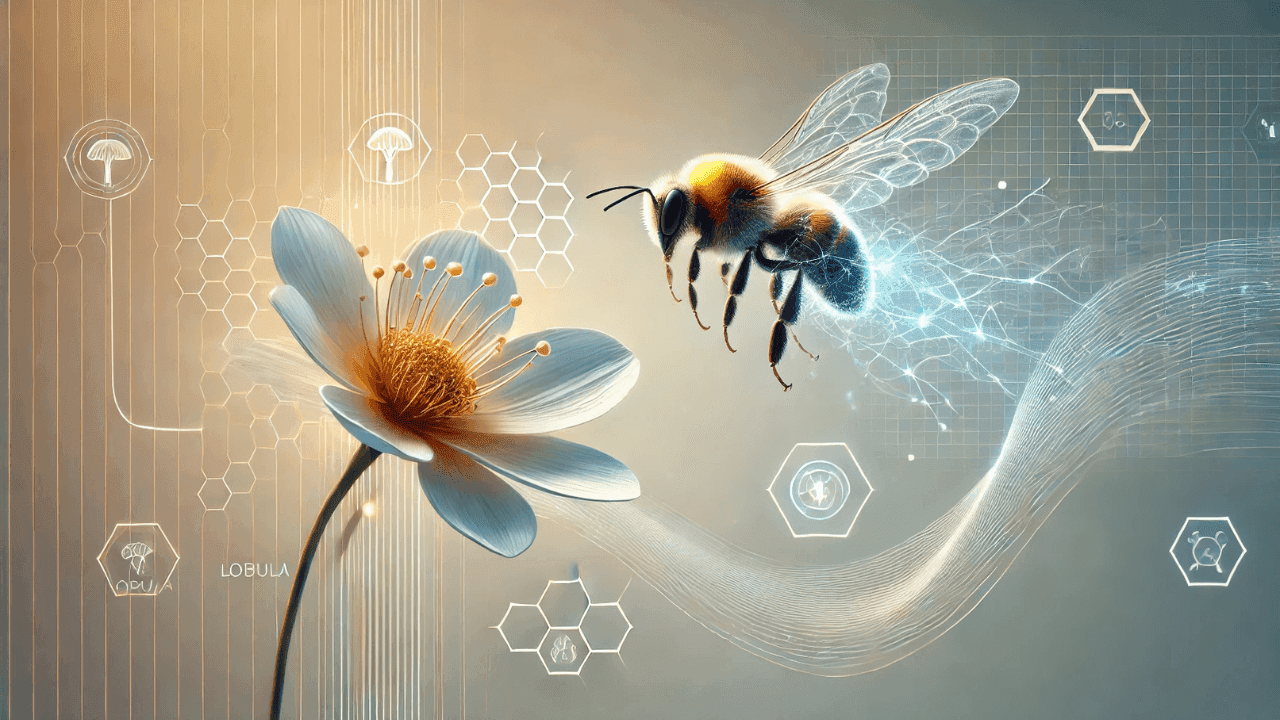
Most of us think of bees as busy creatures buzzing from flower to flower. But behind those tiny wings and compound eyes lies a remarkable secret. Bees don’t just fly. They scan. They move in careful patterns that help their small brains process the world in ways that challenge our own technology.
A new study published in eLife shows how bees use this scanning strategy to recognize shapes, flowers, and even human faces. The researchers didn’t stop at observation. They built a computer model that mimics the bee’s brain and flight behavior. The results could reshape how we design artificial intelligence, especially for machines that need to see and respond quickly.
Fast Facts
- Project: Bee-inspired vision model that uses scanning to read scenes efficiently.
- Goal: Turn movement-based perception into compact codes for pattern recognition.
- Why it matters: Can power lighter, energy-saving AI for drones, robots, and wearables.
- Key result: The model learned shapes and faces using few neurons when it scanned first.
- Takeaway: Choose what to look at, then learn fast. Movement improves machine vision.
How Bees See the World
Bees do not view the world the way humans do. Our eyes capture large scenes in detail. A bee’s compound eyes are different. They have lower resolution, so bees cannot see fine details in one glance. To solve this, bees move deliberately, scanning objects piece by piece.
Think of it like how a barcode scanner works. Instead of processing the entire code at once, it sweeps across it, collecting small slices that form a complete picture. Bees do the same. As they hover in front of flowers, they sample colors, edges, and patterns step by step.
This behavior, known as active vision, turns a potential weakness into a strength. By moving, bees create a sequence of snapshots that their brains can stitch together into meaningful information.
What The New Study Did
The research team, led by scientists from the University of Sheffield and Queen Mary University of London, wanted to understand how scanning shapes brain activity. They built a computer model inspired by bee vision. This model included three main parts of the insect brain:
- Lamina – the first stop for visual signals.
- Medulla – where signals are sorted.
- Lobula – the region that integrates moving images.

When the model “scanned” an image, just like a bee would, the lobula neurons organized themselves to respond to edges, angles, and motion. The result was a compact “code” that represented visual information with very little waste.
Lead author HaDi MaBouDi explained the motivation:
“In our previous work, we were fascinated to discover that bees employ a clever scanning shortcut to solve visual puzzles. But that just told us what they do; for this study, we wanted to understand how.”
Surprisingly, the model did more than recognize simple bars or shapes. It could discriminate between plus and multiplication signs. It even succeeded in recognizing human faces in experiments designed to test its ability.
Why This Matters For AI And Robotics
Modern AI systems, like the ones that power self-driving cars or facial recognition, require vast computing resources. They process every pixel of every frame, which takes energy and time. Bees show us another way.
By scanning and focusing only on the most useful parts of a scene, bees create efficient codes that are sparse and uncorrelated. In simple terms, their brains do more with less.
Professor James Marshall, senior author, put it this way:
“We’ve learned that bees, despite having brains no larger than a sesame seed, don’t just see the world, they actively shape what they see through their movements. It’s a beautiful example of how action and perception are deeply intertwined to solve complex problems with minimal resources.”
If we apply this principle to robotics and AI, the results could be powerful:
- Smaller drones could use bee-inspired vision to navigate cluttered environments.
- Search-and-rescue robots could scan disaster zones efficiently.
- Wearable devices could recognize surroundings with minimal battery use.
This shift would not only save energy but also open the door for devices that are lighter, cheaper, and smarter.
Who Stands to Benefit
The implications reach far beyond bee research.
- Neuroscientists gain insight into how small brains perform big tasks.
- AI and robotics engineers can design systems that are less resource-hungry.
- Ecologists can better understand pollination and animal behavior.
- Everyday people may one day use gadgets that rely on this kind of efficient vision.
The study is a reminder that nature often solves problems in ways that outperform human inventions.
Stories from the Lab: From Flowers to Faces
One of the most surprising findings was the model’s ability to recognize human faces. Real bees have shown this skill before, which puzzled scientists. How could an insect with such a small brain manage a task that challenges even some AI systems?
The answer lies in their scanning. Bees do not take in the whole face. Instead, they scan edges, contrasts, and key features, creating a simplified but effective internal picture.

Professor Lars Chittka highlighted the deeper meaning:
“Scientists have been fascinated by the question of whether brain size predicts intelligence in animals. But such speculations make no sense unless one knows the neural computations that underpin a given task. Here we determine the minimum number of neurons required for difficult visual discrimination tasks and find that the numbers are staggeringly small, even for complex tasks such as human face recognition. Thus, insect microbrains are capable of advanced computations.”
The model mirrored bee behavior. When trained, it successfully identified and rejected faces in tests. This shows that efficient coding combined with scanning can handle surprisingly complex tasks.
A Concrete Example: Plus vs. Multiplication
To test the system, the researchers gave both real bees and the computer model a choice between a plus sign and a multiplication sign. At first glance, these symbols look similar. Yet with scanning, bees focused on the lower parts of the symbols and learned to tell them apart.
The model did the same. When it scanned only the most important regions of the symbols, it reached accuracy levels close to real bees. When it tried to view the entire pattern at once, its performance dropped.
This shows that less is more when it comes to bee vision.
Related Reading
Scientists built a tiny molecule that stores energy from sunlight, a step toward clean solar-made fuels. The approach could work even in dim light and make artificial photosynthesis more practical.
Read the Full StoryThe Emotional Connection: Respect for the Small
There is something humbling about this discovery. Bees, with brains smaller than a sesame seed, may hold the key to building the next generation of smart machines. It challenges the assumption that size and power are everything.
MaBouDi himself summed it up beautifully:
“We’ve learned that bees, despite having brains no larger than a sesame seed, don’t just see the world—they actively shape what they see through their movements. It’s a beautiful example of how action and perception are deeply intertwined to solve complex problems with minimal resources.”
For centuries, humans have looked to nature for inspiration. Birds inspired flight. Dolphins inspired sonar. Now bees may inspire smarter vision in machines.
Beyond Bees: A Global Lesson
Active vision is not limited to bees. Humans move their eyes constantly to scan details. Other insects and animals also rely on scanning. But bees show a unique efficiency that works even with limited brain power.
Professor Mikko Juusola explained why this is important for both biology and technology:
“Our new model extends this principle to higher-order visual processing in bees, revealing how behaviorally driven scanning creates compressed, learnable neural codes. Together, these findings support a unified framework where perception, action and brain dynamics co-evolve to solve complex visual tasks with minimal resources—offering powerful insights for both biology and AI.”
The lesson is universal. Movement is not just about getting from place to place. It is also about how brains gather and process information. This principle could apply to AI across industries and across the globe.
The Limitations and Next Steps
The researchers admit that their model simplifies reality. Real bees use more complex flight paths, head movements, and adaptive strategies. The model focused on scanning in straight lines. Future work may explore how bees adjust in real time to moving flowers or changing light conditions.
Still, even with its limits, the model proves the power of active vision. It suggests that adding movement strategies to AI could transform the way machines see and learn.
Conclusion: A Tiny Brain, A Giant Idea
Next time you watch a bee hover over a flower, imagine the hidden intelligence at work. That little insect is not only collecting nectar. It is scanning, coding, and making sense of the world with a brain smaller than a crumb.
Scientists are now translating this ability into technology. If successful, we may one day live in a world where machines see with the same elegance as bees. That is a future where less energy, smarter design, and natural inspiration come together.
Related Reading
Scientists recently discovered that bacteria living in a mother’s stomach may play a surprising role in shaping a baby’s brain. This breakthrough could change how we think about early development.
Read the Full StoryFrom obsession to clarity — one original question every week.
We answer one noisy topic at a time, in full. No daily roundup, no thread bait — just the question, the principles, and the system.