
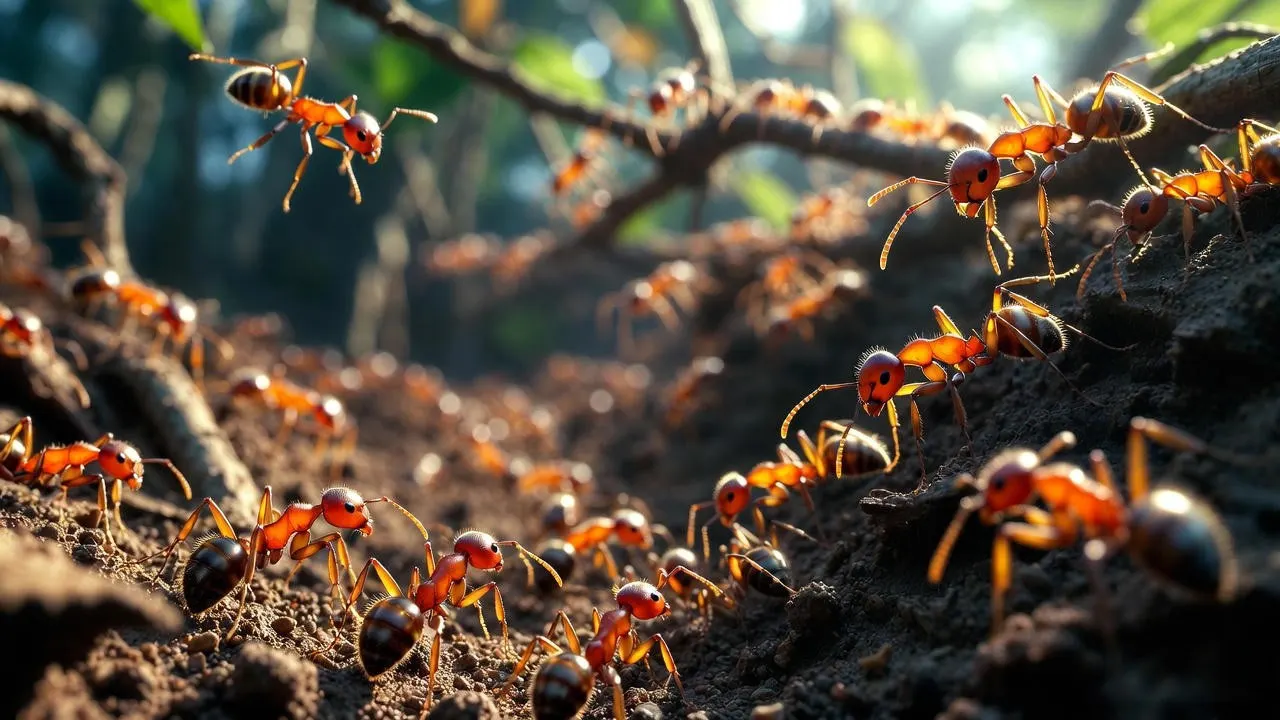
Tiny ants traded heavy protection for many more workers and built huge colonies that helped them thrive and diversify.
Ants appear tiny and simple, but a new study reveals a surprising strategy behind their success. Researchers found that some ant species spend fewer resources on each worker’s body armor. Instead, they make many more workers. This shift let colonies grow huge and explore new environments in ways that stronger but fewer ants could not.
Finding: New research shows many ants evolved lighter, less armored bodies to create more workers. Method: Scientists studied hundreds of ant species using 3D imaging and evolutionary analysis. Impact: Colonies with cheaper workers grew larger, spread faster, and formed new species more easily. Why It Matters: The findings reveal how cooperation and numbers can outperform individual strength in evolution.
The heart of this discovery lies in the balance between strength and numbers. The researchers measured how much ants invest in their cuticle, the hard outer layer that protects their bodies. They found that species that put less into this armor tended to have bigger colonies. Those bigger colonies then appeared more likely to split into new species, a key mark of evolutionary success.
To reach this finding, the team looked at 3D X-ray scans from more than 500 ant species. These scans let them compare total body size with how much of that body was protective cuticle. They then used evolutionary models to see how cuticle investment related to colony size and species diversity over long time scales. By looking across hundreds of species, patterns emerged that would be invisible in a single species study.
This matters because it reshapes how we think about what makes social animals successful. Instead of needing super-strong individuals, some ant groups got ahead by having many workers that rely on teamwork for defense, food gathering, and nest building. That helps explain why ants dominate many ecosystems around the world today.
Experts say this changes how scientists view tradeoffs in evolution. Evan Economo, the lead senior researcher, said individuals in a society can become simpler as the group’s cooperation grows stronger. Arthur Matte, the study’s lead author, explained that shifting resources away from individual armor freed up nutrients to make more workers. This idea echoes patterns seen in other complex systems where quantity can outweigh individual quality.
This discovery touches on bigger ideas beyond ants. It links to questions in technology, economics, and social organization about when numbers beat strength. For example, some computer systems use many simple parts together rather than a few powerful ones. In culture and history, armies and workforces have succeeded by combining many contributors rather than relying on a few elite individuals.
There is more to learn. Scientists still do not know exactly why less protection helps ants explore new habitats so well.
Future work may test whether this strategy appears in other social insects like termites or even in animal groups beyond insects. Researchers also want to understand how environmental limits on nutrients might drive these evolutionary choices.
This study reveals a simple but powerful idea: success in nature often comes from balancing cost and cooperation. By making cheaper workers and focusing on teamwork, ants built the largest social systems on Earth and diversified into countless forms that fill ecosystems today.
Story Source:
Materials provided by University of Maryland. Content may be edited for style and length.
Journal Reference:
Arthur Matte, Benoit Guénard, Shubham Gautam, Fumika Azuma, Julian Katzke, Francisco Hita Garcia, Thomas van de Kamp, Evan P Economo. The evolution of cheaper workers facilitated larger societies and accelerated diversification in ants. Science Advances, 2025. 11(51). DOI: 10.1126/sciadv.adx8068