5 Insurance Solutions for High-Risk Roofing Projects
Explore 5 insurance solutions for high-risk roofing projects, including coverage options, specialty providers, and tips for managing contractor risks.

Steep-slope tear-offs, multi-story commercial reroofs, and storm-damage restoration all carry exposure levels that standard business insurance wasn't built to handle. Finding the right insurance for high-risk roofing projects means matching coverage structure to actual jobsite risk, not just buying the cheapest general liability policy available. Here are five providers worth knowing.
Insurance for high-risk roofing: what contractors really need
Roofing ranks among the most hazardous trades in construction, and insurers price it accordingly. A general liability policy covers third-party bodily injury and property damage, but most high-risk roofing jobs also require workers' compensation structured around elevated fall exposure, commercial auto for crew vehicles, and on larger contracts, excess or umbrella layers that sit above the main policy limits.
Bid qualification on commercial or multi-family projects now routinely demands certificate limits of $2M per occurrence or higher. When a job falls under a general contractor's controlled insurance program (CCIP), the roofing sub's own policy has to coordinate with that wrap-up structure. That coordination doesn't happen on its own with an off-the-shelf policy.
The five options below range from specialty brokerages built for large contractors to carrier-direct programs suited to smaller or mid-size operations.
- Unlimited Contractors Insurance
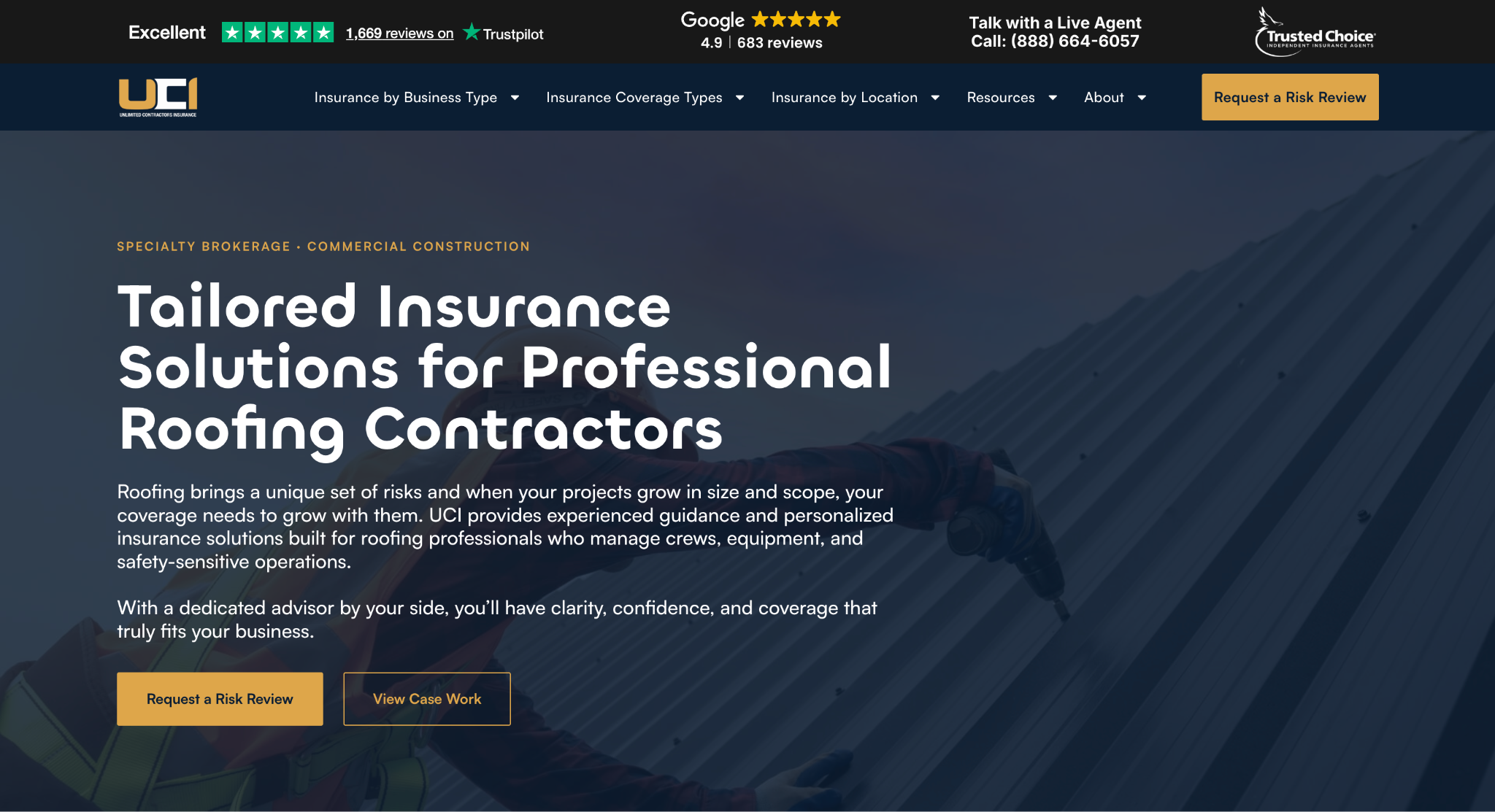
Unlimited Contractors Insurance is a specialty commercial brokerage that structures and stewards insurance and risk-transfer programs for construction contractors generating $1M or more in annual revenue, with programs typically sized for contractors in the $5M to $100M+ range.
Where it fits: Roofing contractors doing large commercial volume - multi-state work, large-project exposure, or bids that require high certificate limits - are the right fit here. UCI places general liability, workers' compensation, commercial auto, and excess/umbrella towers up to $100M+, alongside complex risk-transfer programs including OCIP, CCIP, and subcontractor default insurance. Coverage runs through a four-phase stewardship cycle: risk discovery, program design, market placement, and year-round active stewardship. The team holds CPCU and CRIS credentials, averages 15+ years of construction-insurance experience, and places accounts across 30+ carrier markets, including Travelers, The Hartford, Liberty Mutual, AIG, and Chubb. UCI is licensed in 47 states. There's no online quote engine; every submission goes through a live risk-review call, typically answered within 2 business hours to 1 business day.
- The Hartford

The Hartford is a Fortune 500 carrier founded in 1810 and headquartered in Hartford, Connecticut, with roughly 27,220 employees and a long track record in commercial property and casualty lines.
Where it fits: Roofing contractors who want a well-established carrier with broad commercial lines can find general liability, workers' compensation, and commercial auto through The Hartford's network of independent agents and brokers. The company serves over 1.3 million small businesses, so its processes and appetite are calibrated for that market segment. Coverage is distributed through agents rather than sold direct.
Worth checking: The Hartford is a general-market carrier, not a construction specialist. Roofing contractors with complex exposure - multi-state operations, high excess limits, or wrap-up program coordination - may find that a generalist carrier's appetite is narrower than a specialty brokerage can offer.
- Travelers

Travelers is the second-largest writer of U.S. commercial property and casualty insurance, founded in 1853 and headquartered in New York City, with approximately 34,000 employees and $48.83 billion in revenue as of 2025.
Where it fits: Travelers has an explicit construction-sector practice and offers general liability, workers' compensation, commercial auto, surety bonds, and umbrella coverage. Its construction industry products are distributed through independent agents and brokers, so access depends on the agent's relationship with Travelers' underwriting desk. The company's scale means it can accommodate a wide range of contractor sizes, from smaller specialty trades up through larger commercial operations.
Worth checking: Travelers operates through independent agents, meaning pricing and program access vary by agent relationship and region. Roofing contractors with high-severity loss histories may find underwriting appetite more restrictive at a standard carrier than at a specialty brokerage with broader market access.
- Thimble (Arch)
Arch Insurance North America, operating under the Arch Capital Group (founded 2001, headquartered in Jersey City, NJ), is a specialty insurer covering property, casualty, and specialty lines for corporations, professional firms, and financial institutions across the U.S. and Canada.
Where it fits: Arch focuses on specialty and surplus lines, which can include hard-to-place risks, a relevant angle for roofing contractors whose loss history or project type makes standard-market placement difficult. Arch operates 23 U.S. offices with 1,400+ employees and places coverage across management liability, cyber, professional liability, and other specialty lines, in addition to broader property and casualty products.
Worth checking: Arch's published focus leans toward corporate and institutional buyers rather than individual trade contractors. Roofing contractors looking for this carrier would typically access it through a wholesale broker or surplus lines specialist rather than directly.
- Nationwide
Nationwide Mutual Insurance Company was founded in 1926, is headquartered in Columbus, Ohio, and is ranked No. 72 on the 2025 Fortune 500, with approximately 24,000 employees and an A+ rating from Standard & Poor's.
Where it fits: Nationwide offers a wide range of commercial insurance products, including general liability, workers' compensation, commercial auto, surety, and umbrella, through its agent network. The company's financial strength rating makes it a solid choice for contractors who need to show carrier financial stability on bonding or large-contract prequalification forms. Nationwide's commercial lines are available through independent agents across most of the country.
Worth checking: Like most large mutual carriers, Nationwide's commercial construction appetite is shaped by individual underwriters and regional offices. Contractors with elevated roofing exposure should confirm program availability with a local agent before assuming coverage terms will match their project profile.
What actually makes a roof uninsurable (and how to avoid it)
A handful of factors push roofing contractors into the surplus lines market, or get them declined altogether. A high experience modification rate (EMR), typically anything above 1.25, tells underwriters that workplace injuries are running above the trade average. From there, carriers will either decline the account, attach a steep surcharge, or demand a detailed loss-control plan before they'll bind coverage.
Certain project types also trigger underwriting scrutiny. Wood shake and cedar shingle work, steep-pitch residential reroofs above four stories, and jobs involving torch-applied membrane on occupied buildings all carry elevated loss potential. Contractors doing this work need to disclose it accurately on applications; misrepresentation is a coverage-denial risk on an actual claim.
The practical fix is documentation. Safety programs, OSHA 10/30 training records, written fall-protection plans, and subcontractor prequalification procedures all lower the underwriting risk profile on paper and in the real world. Contractors who can show a declining claim trend over three to five years of loss runs tend to get better terms than those presenting their first application with no history at all.
Specialty brokerages with construction focus can help structure a submission that presents loss history in context, rather than letting a raw EMR speak for itself.
Bottom Line
The best insurance for high-risk roofing projects isn't one product. It's the right mix of coverage lines, limits, and a carrier or brokerage that genuinely understands construction exposure. Large commercial roofing contractors running multi-state operations with heavy certificate requirements need a very different structure than a small residential crew bidding local jobs. Matching program complexity to actual project risk is what separates adequate coverage from coverage that holds when a claim hits.
Author Bio
Megan Sutton is a business writer specializing in commercial insurance, risk management, and contractor protection. She covers industry trends and practical strategies to help roofing professionals navigate complex coverage requirements and make informed insurance decisions.
The weekly question
From obsession to clarity — one original question every week.
We answer one noisy topic at a time, in full. No daily roundup, no thread bait — just the question, the principles, and the system.